Engineering for Nanoscale Confined Space -Active use of interfaces for structure control-
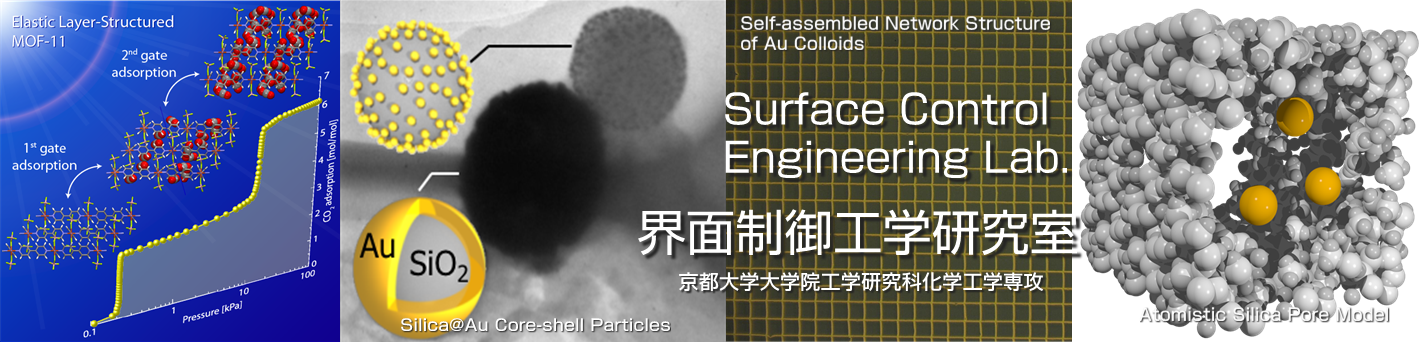
An interface/surface is a region where two phases with different properties come into contact, where molecules experience an asymmetric environment and thus exhibit properties distinct from those in the bulk. Our research focuses on nanoscale spaces—such as porous materials and nanoparticles—where interfacial effects are particularly pronounced. By combining molecular and particle simulations with experiments, we analyze and model the behavior and structure of molecules and particles. Through this approach, we aim to establish a fundamental understanding of chemical engineering involving interfaces and structure, while linking microscopic structure to macroscopic function toward the development of functional materials and the design of related processes.
ナノスケール拘束空間の工学 ー構造制御を目指した界面場の積極利用ー
「界面」とは,性質の異なる二つの相が接する領域であり,分子が非対称な環境に置かれることで,バルクとは異なる特性が発現します。京都大学大学院工学研究科化学工学専攻 界面制御工学研究室では,界面効果が顕著に現れるナノスケール空間(多孔性やナノ粒子)に着目し,分子や粒子の挙動・構造を,シミュレーションと実験を組み合わせて解析・モデル化しています。界面と構造が関与する化学工学基礎の体系化を目指すとともに,ミクロ構造とマクロ機能を結びつけ,機能性材料の創製やプロセス設計へと展開する研究を進めています。